AWS Builder Center Celebrates One-Year Milestone, Transforming Cloud Development with Robust Community Features and Sandbox Environments.

Launched on July 9, 2025, the AWS Builder Center has swiftly evolved from a nascent community hub into a comprehensive ecosystem, marking its first anniversary last week with significant advancements and robust user engagement. What began as a platform offering Wishlist voting, community profiles, and a foundational toolbox has burgeoned into an indispensable resource for cloud developers, now featuring sandbox environments, dedicated Spaces for community groups, structured workshops, and an extensive Builders’ Library. This rapid expansion underscores Amazon Web Services’ commitment to fostering an empowered, skilled, and collaborative global builder community.
The Genesis of AWS Builder Center: Empowering the Cloud Generation
The creation of the AWS Builder Center was a strategic move by Amazon Web Services to address the escalating demand for accessible, hands-on learning and collaborative environments within the rapidly expanding cloud computing landscape. Recognizing that traditional documentation and isolated tutorials, while valuable, often fell short in providing a dynamic, interactive experience, AWS envisioned a central platform where builders could not only learn but also contribute, share, and experiment without friction. The initial concept aimed to democratize access to AWS knowledge and resources, lowering the barrier to entry for aspiring cloud professionals and providing a rich repository for seasoned experts.
At its core, the Builder Center sought to cultivate a vibrant, self-sustaining community where peer-to-peer learning and innovation could thrive. This vision materialized on July 9, 2025, with the launch of a platform designed to be more than just a content repository; it was intended as a living, breathing space for interaction and growth. The initial features—community profiles, a wishlist system for suggesting new functionalities, and a basic toolbox—laid the groundwork for what would become a far more expansive and integrated environment. The platform’s initial focus was on creating a sense of belonging and providing mechanisms for users to directly influence its development, a philosophy that has guided its evolution throughout its inaugural year.
A Year of Rapid Evolution: Key Milestones and Feature Rollouts
The past year has witnessed an aggressive and user-centric development roadmap for the AWS Builder Center, with a continuous stream of features designed to enhance the builder experience. Rick Suttles, a prominent figure in the platform’s development, recently published a comprehensive feature timeline detailing the myriad additions since its inception. This timeline illustrates a methodical approach to expanding functionality, moving beyond basic community tools to offer powerful developmental resources.
One of the earliest significant enhancements was the integration of AWS Capabilities by Region, providing users with a granular view of over 1,500 services available across 37 AWS Regions. This feature is crucial for builders designing global architectures or seeking to optimize resource deployment based on regional availability and compliance requirements. It reflects AWS’s understanding of the global nature of cloud development and the need for comprehensive, up-to-date information.
The platform soon introduced Spaces, enabling community members to create and manage their own groups. This fostered specialized discussions, project collaborations, and localized meetups, effectively decentralizing community organization and allowing organic growth of niche interests within the broader AWS ecosystem. Following this, the launch of workshops with category and complexity filters provided structured learning paths, making it easier for users to find relevant hands-on exercises tailored to their skill level and areas of interest. These workshops range from introductory concepts for beginners to advanced topics for experienced professionals, often leveraging real-world scenarios.
To incentivize engagement and skill development, a badges and streaks system was introduced in March 2026. This gamified approach encourages continuous learning and participation, recognizing achievements and fostering a sense of accomplishment among builders. The platform also rolled out features like article series, allowing authors to publish multi-part content, and crucial metrics such as view counts and saved items, which empower users to track the popularity of their contributions and curate their personal learning resources. Further enhancements included student status verification, offering tailored resources for academic users, and availability notifications for new content or features. Streamlined access was also prioritized with sign-in options via GitHub and Amazon accounts, simplifying the onboarding process for a wide array of developers.
Community Engagement and Content Flourish
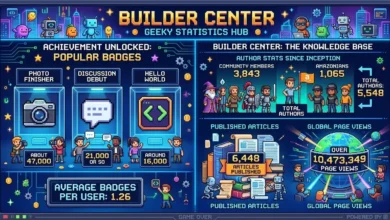
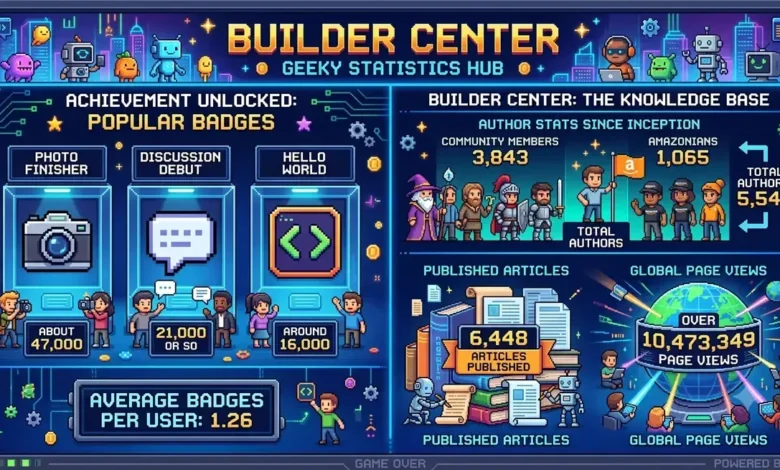
The first year of the AWS Builder Center has been a resounding success in terms of community engagement and content generation. Jeff Barr, a renowned figure within the AWS community, published a retrospective summarizing the platform’s inaugural year, highlighting impressive statistics that underscore its impact. Since its launch, a remarkable 5,548 authors have contributed 6,448 articles, collectively garnering over 10.4 million page views. This volume of content signifies a vibrant and active community eager to share knowledge and insights.
The badge system, launched in March 2026, has seen immense popularity, with builders earning 99,226 badges. This figure not only reflects active participation in workshops and learning paths but also demonstrates the effectiveness of gamification in driving sustained engagement. Furthermore, the community’s voice has been heard through the Wishlist feature, with 565 wishes submitted. Encouragingly, 10 of these community-requested features have already been shipped, with another 20 slated for the near-term roadmap, illustrating a responsive development approach that genuinely values user feedback.
Several articles have particularly resonated with the community, achieving exceptional viewership. Dineshraj Dhanapathy’s "Building an AWS Study Buddy with MCP + Strands Agents SDK" emerged as the top community article, surpassing 50,000 views. This article’s success highlights the community’s interest in practical applications of cutting-edge AWS services for learning and development. Following closely, Chris Miller’s "Migrating an EOL Linux Server to AWS in 8 Hours with Kiro" garnered over 45,000 views, demonstrating the demand for solutions addressing common enterprise challenges like legacy system migration. Yash Aggarwal’s "AIdeas: NeuroVoice – Multimodal AI for Early Screening of Neurological Diseases" secured over 38,000 views, showcasing the community’s deep interest in advanced AI/ML applications and their potential for significant real-world impact in healthcare. These top articles exemplify the diversity and practical utility of the content contributed by the builder community.
Empowering Experimentation: The Sandbox Environment
A standout addition during the anniversary week, and a testament to the platform’s commitment to hands-on learning, is the introduction of Sandbox Environments, a feature authored by Rick Suttles. This innovation directly addresses one of the most significant barriers to cloud learning and experimentation: the need for a personal AWS account, a credit card, and the subsequent management of resources and potential costs.
Sandbox Environments provide users with a free, pre-provisioned AWS account specifically designed to complete workshop exercises. Each environment is active for eight hours, a generous timeframe for focused learning and experimentation. Crucially, after this period, the account and all its provisioned resources are automatically de-provisioned, eliminating the risk of incurring unexpected charges or the hassle of manual cleanup. Builders can have one active sandbox at a time and are permitted to request one per week, ensuring fair access and preventing resource abuse. This feature is a game-changer for new learners and those hesitant to experiment with real AWS accounts, effectively democratizing access to practical cloud experience. It allows for risk-free exploration of AWS services, accelerating skill acquisition and fostering confidence in deploying cloud solutions.
Strategic Vision and Future Outlook
The evolution of the AWS Builder Center over its first year clearly aligns with AWS’s broader strategic vision: to empower developers globally and accelerate the adoption of cloud technologies. By providing a centralized, interactive, and resource-rich platform, AWS is not only supporting its existing customer base but also actively cultivating the next generation of cloud professionals.
AWS officials have indicated that the platform is a crucial component in democratizing access to cloud skills. The emphasis on community-driven content, exemplified by the success of top articles and the responsiveness to Wishlist submissions, underscores a commitment to a truly collaborative development model. The Sandbox Environments, in particular, represent a significant investment in experiential learning, a pedagogical approach known to be highly effective in technical fields. This feature alone is expected to drastically increase the number of individuals who can confidently engage with AWS services, bridging the gap between theoretical knowledge and practical application.
The platform’s growth from a simple hub to a full ecosystem suggests a long-term vision of making the Builder Center the de facto starting point for anyone looking to build on AWS. Its integration of capabilities like regional service availability, structured workshops, and community spaces indicates a desire to serve a diverse audience, from individual learners to enterprise teams seeking best practices.

Broader Impact on the AWS Ecosystem
The AWS Builder Center’s first year of operation has had a palpable impact on the broader AWS ecosystem. By fostering a culture of sharing and learning, it indirectly contributes to the quality and diversity of solutions built on AWS. As more individuals gain hands-on experience through sandboxes and learn from community-contributed articles, the overall skill level of the AWS developer community is elevated. This, in turn, leads to more innovative, efficient, and secure cloud deployments.
The platform also serves as an invaluable feedback loop for AWS itself. The Wishlist feature directly informs product development, ensuring that new features and services are aligned with actual user needs and pain points. The popularity of certain articles or workshop topics provides insights into emerging trends and areas of high interest within the developer community, allowing AWS to tailor its offerings and educational content more effectively.
Furthermore, by making learning accessible and engaging, the Builder Center helps address the global tech talent shortage, particularly in cloud computing. It provides a scalable mechanism for skill development, reaching individuals who might not have access to traditional training programs or expensive certifications. This inclusive approach strengthens the overall talent pipeline for AWS customers and partners, driving innovation across various industries.
Looking Ahead: Continued Innovation
As the AWS Builder Center embarks on its second year, the trajectory of continuous innovation is expected to persist. With a robust foundation built on community engagement, practical learning tools, and responsive development, the platform is poised for further expansion. Future enhancements may include deeper integrations with other AWS learning resources, advanced personalization features, and potentially even more sophisticated collaborative tools for project-based learning. The commitment to a user-driven roadmap, as evidenced by the Wishlist feature, suggests that the community will continue to play a pivotal role in shaping the platform’s evolution.
For a comprehensive overview of all AWS announcements, builders are encouraged to monitor the "What’s New with AWS" page, while the "AWS Blogs" page offers a wealth of additional insights and technical deep dives. Upcoming AWS events also provide invaluable opportunities for learning and networking.
The AWS Builder Center stands as a testament to the power of community and accessible education in the rapidly evolving world of cloud computing. Its first year has laid a strong foundation, promising an even more impactful future for builders worldwide. The platform invites all to visit, meet other builders, contribute solutions, and leverage its growing resources to keep building.
— Esra